American Staffordshire Terrier History: How the AmStaff Separated From the “Pit Bull”
BREEDS A-Z
EXPERT ADVICE
PRODUCTS & SERVICES
SPORTS & EVENTS
CLUBS & DELEGATES
Search
BACK TO DOG BREEDS
American Staffordshire Terrier History: How the AmStaff Separated From the “Pit Bull”
By Denise Flaim
Feb 04, 2021 | 4 Minutes
Ch. Rip Rick Irish Mike, American Staffordshire Terrier. c. 1958
AKC History
Sometimes, in the name of ideology, families get torn asunder. During the Civil War, brothers faced each other across Union and Confederate lines. After World War II, the Berlin Wall separated families, and fates.
And in dogs more than a century ago, we had a similar philosophical divide between the fighting dog known as the American Pitbull Terrier and his pacifist sibling, later to be called the American Staffordshire Terrier.
No use sugarcoating it: Pit bulls were created to be dogfighters and very good ones at that. In England after 1835, when bull- and bear-baiting were officially outlawed, blood sports pivoted to illegal matches that could be less visible, but just as lucrative. Since fighting another dog rather than a chained bear or bull required greater agility, Bulldogs were crossed with terriers to produce fearsomely fleet dogs that would excel in the fighting pit.
(Though it seems counterintuitive, dogs bred for fighting their own kind were intrinsically human friendly. They had to be, in order for these high-stakes matches to run smoothly. According to the cold-blooded rules of the fighting pit, any dog that bit humans – whether the opponent’s handler, the referee, or anyone in the vicinity, even in the heat of battle – did not live to fight another day, and was dispatched on the spot.)
Within a few decades, these “bull and terriers” made their way across the Atlantic. While they were still used for fighting in the States, their rough-and-ready attitude and intense loyalty made them a logical choice for the frontier, where they herded livestock, caught hogs, and guarded home and hearth.
Kirby of Indiana was one of the earliest AKC Champion American Staffordshire Terrier. The breed was recognized by the AKC in 1936. Kirby of Indiana is an example of an early Amstaff Champion.
So Did the AKC Register Pit Bulls?
As pit bulls grew in popularity in the United States, so did their owners’ desire to have them registered as a bona-fide breed. But the American Kennel Club – founded as it was by well-heeled gentlemen who lunched in Manhattan and shot over their Pointers on sprawling Long Island estates – did not want to be associated with the cruelties of the fighting pit. And so in the late 1800s, pit-bull enthusiasts were refused registration of their dogs.
Back in the United Kingdom, the bull and terrier had diverged into two breeds – the Bull Terrier, which left its fighting heritage behind and never looked back – and the Staffordshire Bull Terrier, whose fanciers continued their illegal contests, paralleling the trajectory of the pit bull in the United States. And like their American relatives, Staffordshire Bull Terriers could not gain official acceptance in their native land, for the same reason: No established registry wanted to be affiliated with a dog that drew the blood of its own kind for a living.
It wasn’t until 1935, decades after another round of anti-dog-fighting legislation, that the Kennel Club in Britain formally recognized and registered the Staffordshire Bull Terrier. That paved the way for the American Kennel Club to recognize a subset of the pit-bull population in the United States a year later, after being assured by breeders that they would not allow their dogs to be used for dogfighting.
After considering several names – including the American Bull Terrier (which promptly sent fanciers of the long-established Bull Terrier into a tizzy) and the Yankee Terrier – the AKC settled on Staffordshire Terrier, in a nod to the breed’s roots in Britain’s “black country,” known for its concentration of mines and foundries. That name stuck until 1972, when the AKC decided to recognize the Staffordshire Bull Terrier from across the pond; deciding that Staffordshire Terriers in the U.S. had evolved into a larger, distinctly different breed, the AKC added the word “American” to the name to clearly delineate the two related, but now separate breeds.
American Staffordshire Terrier Colby’s Merle, prominent brood bitch bred by Louis B. Colby. His father John had first encountered the breed in 1888 and Louis followed in his footsteps, producing dogs of remarkable strength found in the bloodlines of most alive today. Fanciers have often gotten tripped up, thinking her name proof the breed had been produced in merle coat color variations, however, it is alleged the name actually came from Colby’s crush on Hollywood actress Merle Oberon.
American Staffordshire Terrier vs. “American Pit Bull Terrier”
When the first 50 or so pit bulls entered the AKC registry in 1936, they became American Staffordshire Terriers, forever setting themselves apart from the related dogs that now called formally themselves “American Pit Bull Terriers.”
(The break isn’t entirely complete, however: Some non-AKC registries that register American Pit Bull Terriers still consider American Staffordshire Terriers to be part of the family, and will register them as pit bulls. But in the 1970s, the AKC permanently closed the studbook for the American Staffordshire Terrier, meaning that today only dogs whose parents are AmStaffs can be considered part of the breed. So while every American Staffordshire Terrier can technically be called an American Pit Bull Terrier, not every American Pit Bull Terrier is an American Staffordshire Terrier.)
The first newly minted American Staffordshire Terrier admitted into the AKC was Lucenay’s Peter, better known to old-movie buffs as Petey, the canine star of the “Our Gang” films, which was later syndicated on television as “The Little Rascals.” Lucenay’s Peter was the second dog to play Petey in the comedy shorts; the first was his father, a pit bull named Pal the Wonder Dog who had a circle around his right eye, thanks to the magic brush of Hollywood makeup artist Max Factor. After Pal was fatally poisoned in 1930, his son Lucenay’s Peter took over, making for an almost seamless substitute, except his ring was around his left eye.
Today’s AmStaff
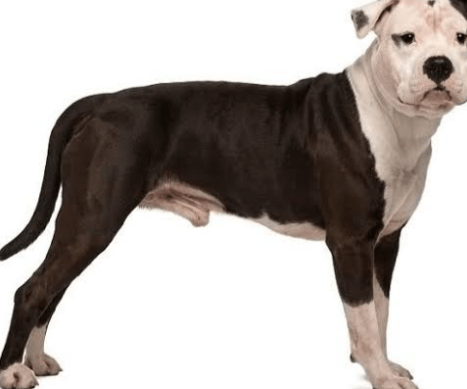
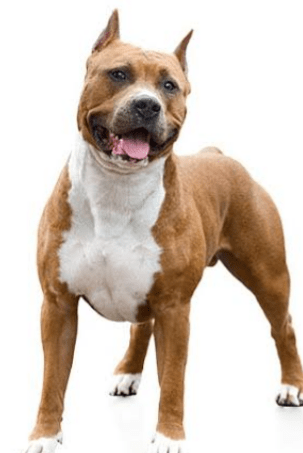
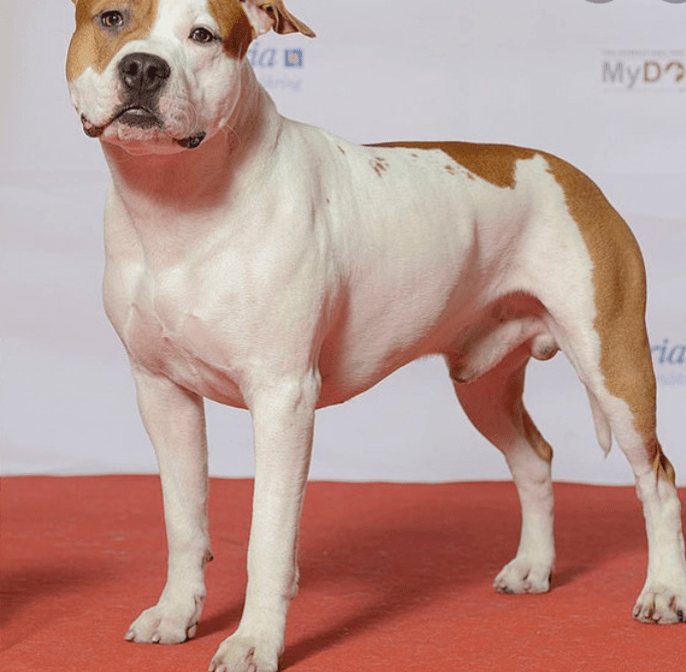
Today, it’s almost a century since the AmStaff parted ways with its pit-bull brethren. Generally speaking, the two breeds look very different, which is not a coincidence: Because pit bulls were bred for one elusive quality – gameness, or the refusal to give up, even under the most excruciating pain – their breeders did not place a premium on appearance. Even today, pit bulls vary wildly in size and shape, from slight, Whippet-type dogs to burly Bulldog wannabes.
American Staffordshire Terriers, by contrast, did not have the demands of the fighting pit to steer their evolution. Instead, their breeders focused on uniform appearance and soundness of body and mind. And if there is one relic of its fighting days that the AmStaff has steadfastly refused to abandon, it is its unabashed love for humans – the species that introduced it to the fighting pit and then later plucked it from the same.er
The American Staffordshire Terrier is a muscular breed known for being strong for its size; however, they’re also loving and affectionate with human family members. American Staffordshire Terriers enjoy nothing more than being with the humans they care about, whether they’re out for a jog, playing in the yard, or cuddling up on the couch.
They are intelligent and eager to please, which makes them highly trainable; although, that intelligence means they need mental stimulation. If they don’t get it, they’ll put those strong jaws to use and chew anything out of boredom. American Staffordshire Terriers can also use their strength to pull dog walkers along with ease wherever they want to go if they aren’t trained properly. This means they need a strong, confident trainer who will set boundaries without being overly harsh.
Socialization is also important to help the breed overcome its natural standoffish tendencies when it comes to other animals. This breed loves having a job to do, and they do well in athletic competitions, police work, and obedience training. With proper training, the American Staffordshire Terrier can be a loyal cuddle bug and family companion, as well as a competent working dog.
See below for full list of dog breed traits and facts about American Staffordshire TerriersIs an American Staffy a good family dog?
The American Staffordshire Terrier is affectionate, loyal, and good with children, making it an outstanding family pet. … The AKC and the Continental Kennel Club separate them, whereas the United Kennel Club combines both within the American Pit Bull Terrier breed.
 Abhi. R. blogger