A fashion trend signifies a specific look or expression that is spread across a population at a specific time and place. A trend is considered a more ephemeral look, not defined by the seasons when collections are released by the fashion industry. A trend can thus emerge from street style, across cultures, from influencers and celebrities.
Fashion trends are influenced by several factors, including cinema, celebrities, climate, creative explorations, innovations, designs, political, economic, social, and technological. Examining these factors is called a PEST analysis. Fashion forecasters can use this information to help determine the growth or decline of a particular trend.
Social influences Edit
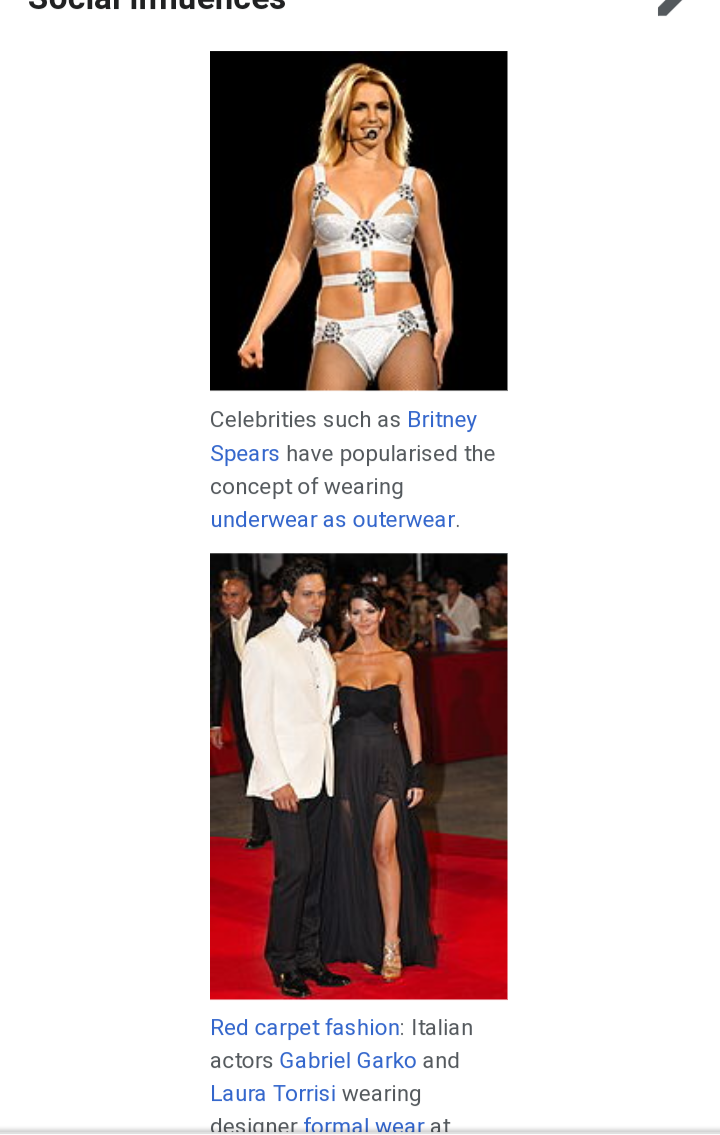
Celebrities such as Britney Spears have popularised the concept of wearing underwear as outerwear.
Red carpet fashion: Italian actors Gabriel Garko and Laura Torrisi wearing designer formal wear at Venice Film Festival, 2009
Fashion is inherently a social phenomenon. A person cannot have a fashion by oneself, but for something to be defined as fashion, there needs to be dissemination and followers. This dissemination can take several forms; from the top-down (“trickle-down”) to bottom-up (“bubble up”), or transversally across cultures and through viral memes and media.
Fashion relates to the social and cultural context of an environment. According to Matika,[37] “Elements of popular culture become fused when a person’s trend is associated with a preference for a genre of music…like music, news or literature, fashion has been fused into everyday lives.” Fashion is not only seen as purely aesthetic; fashion is also a medium for people to create an overall effect and express their opinions and overall art.
This mirrors what performers frequently accomplish through music videos. In the music video ‘Formation’ by Beyoncé, according to Carlos,[38] “The pop star pays homage to her Creole roots…. tracing the roots of the Louisiana cultural nerve center from the post-abolition era to present day, Beyoncé catalogs the evolution of the city’s vibrant style and its tumultuous history all at once. Atop a New Orleans police car in a red-and-white Gucci high-collar dress and combat boots, she sits among the ruins of Hurricane Katrina, immediately implanting herself in the biggest national debate on police brutality and race relations in modern day.”
The annual or seasonal runway show is a reflection of fashion trends and a designer’s inspirations. For designers like Vivienne Westwood, runway shows are a platform for her voice on politics and current events. For her AW15 menswear show, according to Water,[39] “where models with severely bruised faces channeled eco-warriors on a mission to save the planet.” Another recent example is a staged feminist protest march for Chanel’s SS15 show, rioting models chanting words of empowerment with signs like “Feminist but feminine” and “Ladies first.” According to Water,[39] “The show tapped into Chanel’s long history of championing female independence: founder Coco Chanel was a trailblazer for liberating the female body in the post-WWI era, introducing silhouettes that countered the restrictive corsets then in favour.”
The annual Academy Awards ceremony is also a venue where fashion designers and their creations are celebrated.
Social media is also a place where fashion is presented most often. Some influencers are paid huge amounts of money to promote a product or clothing item, where the business hopes many viewers will buy the product off the back of the advertisement. Instagram is the most popular platform for advertising, but Facebook, snapchat, Twitter and other platforms are also used.[40]
Economic influences Edit
Circular economy Edit
With increasing environmental awareness, the economic imperative to “Spend now, think later” is getting increasingly scrutinized.[41] Today’s consumer tends to be more mindful about consumption, looking for just enough and better, more durable options. People have also become more conscious of the impact their everyday consumption has on the environment and society, and these initiatives are often described as a move towards sustainable fashion, yet critics argue a circular economy based on growth is an oxymoron, or an increasing spiral of consumption, rather than a utopian cradle-to-cradle circular solution.
In today’s linear economical system, manufacturers extract resources from the earth to make products that will soon be discarded in landfills, on the other hand, under the circular model, the production of goods operates like systems in nature, where the waste and demise of a substance becomes the food and source of growth for something new. Companies such as MUD Jeans, which is based in the Netherlands employ a leasing scheme for jeans. This Dutch company “represents a new consuming philosophy that is about using instead of owning,” according to MUD’s website. The concept also protects the company from volatile cotton prices. Consumers pay €7.50 a month for a pair of jeans; after a year, they can return the jeans to Mud, trade them for a new pair and start another year-long lease, or keep them. MUD is responsible for any repairs during the lease period.[41] Another ethical fashion company, Patagonia set up the first multi-seller branded store on eBay to facilitate secondhand sales; consumers who take the Common Threads pledge can sell in this store and have their gear listed on Patagonia.com’s “Used Gear” section.[41]
China’s domestic spending Edit
Consumption as a share of gross domestic product in China has fallen for six decades, from 76 percent in 1952 to 28 percent in 2011. China plans to reduce tariffs on a number of consumer goods and expand its 72-hour transit visa plan to more cities in an effort to stimulate domestic consumption.[42]
The announcement of import tax reductions follows changes in June 2015, when the government cut the tariffs on clothing, cosmetics and various other goods by half. Among the changes – easier tax refunds for overseas shoppers and accelerated openings of more duty-free shops in cities covered by the 72-hour visa scheme. The 72-hour visa was introduced in Beijing and Shanghai in January 2013 and has been extended to 18 Chinese cities.[42]
According to reports at the same time, Chinese consumer spending in other countries such as Japan has slowed even though the yen has dropped.[43] There is clearly a trend in the next 5 years that the domestic fashion market will show an increase.
China is an interesting market for fashion retail as Chinese consumers’ motivation to shop for fashion items are unique from Western Audiences.[44] Demographics have limited association with shopping motivation, with occupation, income and education level having no impact; unlike in Western Countries. Chinese high-street shoppers prefer adventure and social shopping, while online shoppers are motivated by idea shopping. Another difference is how gratification and idea shopping influence spending over ¥1k per month on fashion items, and regular spending influenced by value shopping.
Marketing Edit
Market research Edit
Consumers of different groups have varying needs and demands. Factors taken into consideration when thinking of consumers’ needs include key demographics.[45] To understand consumers’ needs and predict fashion trends, fashion companies have to do market research[46] There are two research methods: primary and secondary.[47] Secondary methods are taking other information that has already been collected, for example using a book or an article for research. Primary research is collecting data through surveys, interviews, observation, and/or focus groups. Primary research often focuses on large sample sizes to determine customer’s motivations to shop.[44]
The benefits of primary research are specific information about a fashion brand’s consumer is explored. Surveys are helpful tools; questions can be open-ended or closed-ended. Negative factor surveys and interviews present is that the answers can be biased, due to wording in the survey or on face-to-face interactions. Focus groups, about 8 to 12 people, can be beneficial because several points can be addressed in depth. However, there are drawbacks to this tactic, too. With such a small sample size, it is hard to know if the greater public would react the same way as the focus group.[47] Observation can really help a company gain insight on what a consumer truly wants. There is less of a bias because consumers are just performing their daily tasks, not necessarily realizing they are being observed. For example, observing the public by taking street style photos of people, the consumer did not get dressed in the morning knowing that would have their photo taken necessarily. They just wear what they would normally wear. Through observation patterns can be seen, helping trend forecasters know what their target market needs and wants.
Knowing the needs of consumers will increase fashion companies’ sales and profits. Through research and studying the consumers’ lives the needs of the customer can be obtained and help fashion brands know what trends the consumers are ready for.
Symbolic consumption Edit
Consumption is driven not only by need, the symbolic meaning for consumers is also a factor. Consumers engaging in symbolic consumption may develop a sense of self over an extended period of time as various objects are collected as part of the process of establishing their identity and, when the symbolic meaning is shared in a social group, to communicate their identity to others. For teenagers, consumption plays a role in distinguishing the child self from the adult. Researchers have found that the fashion choices of teenagers are used for self-expression and also to recognize other teens who wear similar clothes. The symbolic association of clothing items can link individuals’ personality and interests, with music as a prominent factor influencing fashion decisions.[48]
Political influences Edit
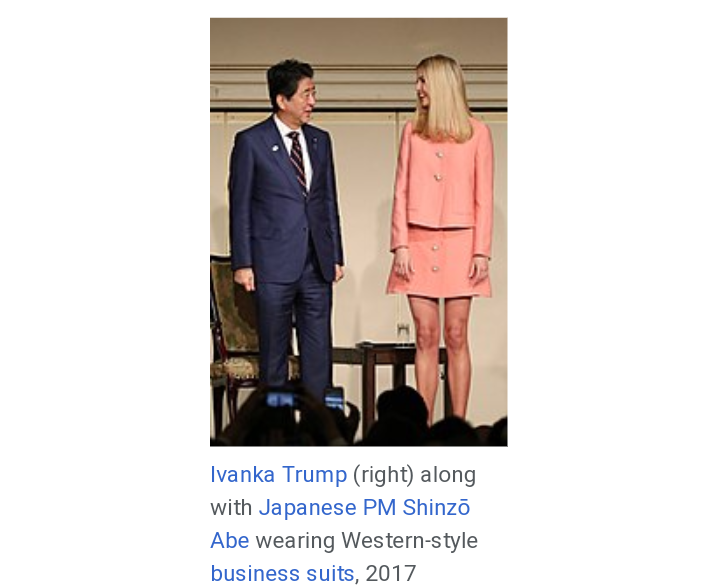
Ivanka Trump (right) along with Japanese PM Shinzō Abe wearing Western-style business suits, 2017
Political figures have played a central role in the development of fashion, at least since the time of French king Louis XIV. For example, First Lady Jacqueline Kennedy was a fashion icon of the early 1960s. Wearing Chanel suits, structural Givenchy shift dresses, and soft color Cassini coats with large buttons, she inspired trends of both elegant formal dressing and classic feminine style.[49]
Cultural upheavals have also had an impact on fashion trends. For example, during the 1960s, the U.S. economy was robust, the divorce rate was increasing, and the government approved the birth control pill. These factors inspired the younger generation to rebel against entrenched social norms. The civil rights movement, a struggle for social justice and equal opportunity for Blacks, and the women’s liberation movement, seeking equal rights and opportunities and greater personal freedom for women, were in full bloom. In 1964, the leg-baring mini-skirt was introduced and became a white-hot trend. Fashion designers then began to experiment with the shapes of garments: loose sleeveless dresses, micro-minis, flared skirts, and trumpet sleeves. Fluorescent colors, print patterns, bell-bottom jeans, fringed vests, and skirts became de rigueur outfits of the 1960s.[50]
Concern and protest over U.S involvement in the failing Vietnam War also influenced fashion . Camouflage patterns in military clothing, developed to help military personnel be less visible to enemy forces, seeped into streetwear designs in the 1960s. Camouflage trends have disappeared and resurfaced several times since then, appearing in high fashion iterations in the 1990s.[51] Designers such as Valentino, Dior, and Dolce & Gabbana combined camouflage into their runway and ready-to-wear collections. Today, variations of camouflage, including pastel shades, in every article of clothing or accessory, continue to enjoy popularity.
Technology influences Edit
Today, technology plays a sizable role in society, and technological influences are correspondingly increasing within the realm of fashion. Wearable technology has become incorporated; for example, clothing constructed with solar panels that charge devices and smart fabrics that enhance wearer comfort by changing color or texture based on environmental changes.[52] 3D printing technology has influenced designers such as Iris van Herpen and Kimberly Ovitz. As the technology evolves, 3D printers will become more accessible to designers and eventually, consumers — these could potentially reshape design and production in the fashion industry entirely.
Internet technology, enabling the far reaches of online retailers and social media platforms, has created previously unimaginable ways for trends to be identified, marketed, and sold immediately.[53] Trend-setting styles are easily displayed and communicated online to attract customers. Posts on Instagram or Facebook can quickly increase awareness about new trends in fashion, which subsequently may create high demand for specific items or brands,[54] new “buy now button” technology can link these styles with direct sales.
Machine vision technology has been developed to track how fashions spread through society. The industry can now see the direct correlation on how fashion shows influence street-chic outfits. Effects such as these can now be quantified and provide valuable feedback to fashion houses, designers, and consumers regarding trends
 Abhi. R. blogger